Physicists May Prove Our Universe is a Computer Simulation
Ridiculous it may first seem, but what if our existence has much more in common with the world of the matrix than what we imagine? Physicists are working to answer this very question.
Unlikely our world is the ‘Matrix’
Thinking logically, it is massively unlikely our existence mirrors the one as featured in the movie, The Matrix. This unlikelihood is easily equated when considering how many other ways our world could progress in the future.
Firstly there is a chance technology could lead to our destruction before the end of this century, through it being used against us by terrorists and criminals. Should we survive our technological advances, we will reach a point when we will develop an
Artificial General Intelligence (AGI). This AGI will be conscious, in the same way that we are. However, it could be far more intelligent, potentially billions of times more intelligent.
With our technology and ourselves at such levels of intelligence, it is not possible to estimate what our future will most likely look like. Possibilities though are endless. The possibility that our machines will enslave us to live in an artificial reality, is just one of billions.
The unlikelihood can be increased to a practical impossibility when we think about the reason machines enslave us in the movie. They enslaved us for energy resources, of which solar energy provides an amount billions of times greater. Also, why place our mind in a Matrix? Why not just place us in comas.
Thinking of it as a future possibility, we can now think of it in terms of – has it already happened? Are we in the Matrix? And the answer is – that is even more unlikely.
But why we might live in a simulation
Having ruled out what is unlikely, we can now think about what is likely. We know that Full Immersion Virtual Reality (FIVR) will be possible in the future,
some believe as soon as 2039. In the future, we will continue to strive for perfection, to have the best possible lives, the aim will be to create a utopia, a paradise. Other than that almost certainty, we can’t even begin to speculate about such a faraway future.
Fresh Life Cycles
What we know now though, is that some people don’t want to live forever. The main
argument against immortality is that, we would eventually get bored. To stop this boredom, an answer could be to live
fresh life cycles. When FIVR is possible, we could use it to allow us to inhabit simulated universes. So what if this is a universe that we are living in now? When we die, perhaps we will wake up in the real world with all the memories of our immortal life restored. This possibility is more likely than the possibility that we live in the world of The Matrix, but it is still one which is rather unlikely.
Birthing Universe
Then though, we have even more reasons why we might be in a simulation. What if this universe is a ‘birthing universe’. What if it is just one of many universes used to create intelligent beings, and it is the first stage of another life outside of this simulated universe. It could be used to ensure that, outside of our simulation, only good moral people exist. Perhaps we are being judged here and if we are deemed to be bad people, when we die, we will not be revived. Again, a rather unlikely, yet possible theory.
Ancestor-Simulations
It is proposed by Swedish philosopher Nick Bostrom (director of both
The Future of Humanity Institute and the
Programme on the Impacts of Future Technology as part of the
Oxford Martin School at Oxford University), that in the future, our distant descendants will build ‘Ancestor-Simulations’. These simulations will be created with the aim to discover in detail how they were created, how they had evolved, and how likely they were to have survived the
technological singularity. Thinking in terms of probability: If one real universe is able to create many (potentially infinite) simulated universes, it would be concluded as a next to certainty that if we are any of these universes, we are one the those that are simulated. And then if in those simulations they can create their own simulated universes, we could just quit the argument now and just say, we must be a simulation. However, it would be extremely naive to take this view while so many incomprehensible possibilities exist.
All Universes are ‘Simulated’
Perhaps simply with it being possible to create infinite simulated universes, they have been made just for the hell of it. Why not? If there is space for life to exist, then why not let it live? Perhaps we are one of an infinite number of universes just left floating around. And then, if simulated universes can be made within simulated universes, there could be potentially infinite levels of simulations (Simulations in simulations in simulations, etc). Logically, the deeper we get into these levels of simulation, the less likely we are to exist for long, because more chance will exist that, at one level at least, the simulation could be destroyed.
So what is perhaps more likely then, is that there are these infinite levels of simulated universes, but at the very top of the pile, we have the ‘real world’, whatever that might be, and from that real world, all simulations are being regulated in some way. Or perhaps, infinite simulations are allowed to exist, but only to one level of simulation; so when we are able to create a simulated universe, we will be stopped by the ‘regulator’. This seems logically like a very likely type of simulation we could be living in.
And with that likelihood, we have to rethink how we think of the word, ‘simulation’: Spiritual religions would call it the mortal world, and they would call the ‘real word’, heaven (the world where exists their God).
That is enough of the speculation. What proof do we have?
The Search for Proof
The idea that we live in a simulation is subscribed to by Nick Bostrom, who published a paper proposing it in 2003. You can read that paper,
here. A debate website about the paper can be found,
here. It is, in my opinion, the best starting point to begin research on the theory. Below is a video of Nick Bostrom explaining his Simulation Argument.
Universe of Mysterious Perfection
Evidence proposed for the Simulation Argument is mostly set on the basis of the mysterious coincidences that enable the universe to exist, and for it to be habitable for life. About two-dozen of the universe’s fundamental constants happen to fall within the narrow range thought to be compatible with life. Should the parameters be jiggled just slightly, not even stars and galaxies would exist, let alone life as we know it. The existence of these coincidences is called, the
Anthropic Principle.
Scientifically Hypothesized Evidence
Currently, the Simulation Argument lives only in the philosophical arena. It is now though being proposed by physicists that it is possible to gain evidence that our universe experiences constraints that would only be possible within a simulation; it could be proved that our laws of physics are not natural, but are artificially imposed on us. This proof would be obtained through our creating our own simulated universe.
The complexities of building a simulated universe are enormous. For details of the complexities, you can visit,
here. Currently, even the best supercomputers can only simulate a few femtometers across (far less than the size of a single atom), within a simulation identical to our universe.
Eventually though, more powerful simulations will be able to model much more. But it will take at least another few decades of exponential growth until we have enough computing power to simulate a large enough chunk of the universe to understand the constraints that would indicate we are living in a simulated universe.
Potential Upcoming Experiment
The University of Washington (UW) though propose that evidence of the above described constraints can be gained with our current or upcoming computing power. Martin Savage, a UW physics professor, has explained that the experiment would utilise supercomputers that are capable of using a technique called lattice quantum chromodynamics (Lattice QCD). It would take a lot to explain what exactly Lattice QCD is; the most comprehensive explanation can be found on Wikipedia,
here.

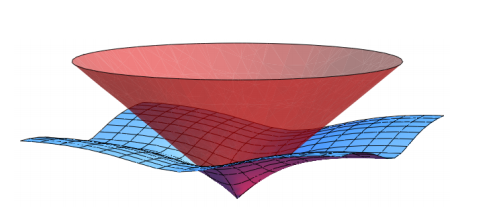
The conical (red) surface shows the relationship between energy and momentum in special relativity, a fundamental theory concerning space and time developed by Albert Einstein, and is the expected result if our universe is not a simulation. The flat (blue) surface illustrates the relationship between energy and momentum that would be expected if the universe is a simulation with an underlying cubic lattice. Credit – Martin Savage
They would start by programming into that supercomputer the fundamental physical laws that govern our universe. This would be done on a three dimensional lattice which advances in steps of time (space-time continuum). The scale of this simulation would only be possible for now at the incredibly small femto scale.
Even at this miniscule scale though, the UW are confident that they can create an experiment and gain practical results. Inside the simulation, they explain that they will recreate ultra high energy cosmic rays. The ultra high frequency nature of these rays is what will allow them to exist in the miniscule simulated environment.
Now the interesting thing about these cosmic rays (and the reason they will be used in the experiment), is that we suspect they have a ‘cut off point’; their energy level (frequency) has an identified limit.
What the experiments are looking for
Physicists theorise that our universe sits on an underlying grid. This grid is what all matter (all you see, and all you are) sits on. The finite distance between each point on the grid is called the Planck length. Anything smaller than this Planck length, cannot exists.
So anything at the very edge of space is anything small enough (at a high enough frequency) to only just exist on the grid.
In one of two scenarios presented by physicists, ultra high energy cosmic rays (UHECR’s) have a ‘frequency cut off point’ (GZK cut off), and that cut off point is caused because any higher frequency could not exist on the grid. Should this be true, then inside the simulation that we hope to create, by studying the signatures presented by the simulated UHECR’s, we will identify a signature that identifies a boundary (the rays will reflect the symmetry of the underlying lattice).
Should that signature be identified, then it will be confirmed that the otherwise natural frequency range of cosmic rays are limited by universe constraints. It will be concluded that the lattice on which we exist, exerts limits on what it holds, and therefore potentially that lattice will be ‘unnatural’, because it will limit what is otherwise natural.
The other scenario is that the lattice spacing of the universe (Planck length) is much smaller than the corresponding length scale of the GZK cut off, or even that the lattice spacing shrinks in response to its environments needs, to allow for frequencies to rise as far as they do normally, naturally and uninterrupted . Should this be true then the lattice will not be visible through the signatures of UHECR’s.
Still many more possibilities
Even with the proof that our universe has constraints caused by lattice spacing, any conclusions would be limited by the possibility that everything we think we understand about simulations, could be flawed.
Further Reading
Hope for Simulation
The final thought I will leave this on is from a quote by Nick Bostrom;
“Unless we are now in a simulation, our descendants will almost certainly never run an ancestor-simulation”.
If no civilization manages to survive to become technologically able to create their own simulated universe, then we are not in a simulation. Which mean that we are also destined to not survive the transcendence of our biology. The destruction of worlds would most likely be self-inflicted, through war, terrorism, criminality, or accident.
If hope exists for our survival, then perhaps we almost certainly must be in a simulation.